Everyone wants the "four-hour workweek."
They want the robots to do the heavy lifting while they sip espresso in Dubai. I get it. I live it. But here is the cold, hard truth: most founders are doing business automation all wrong.
They treat it like a magic wand. They buy a subscription to Zapier or a high-end CRM, click a few buttons, and expect their bank account to grow. Instead, they end up with a digital mess, broken links, and frustrated customers.
I’ve seen it a thousand times.
If your workflow automation for small business feels like a second job, you’ve missed the point. Automation should give you freedom: not a new list of technical headaches.
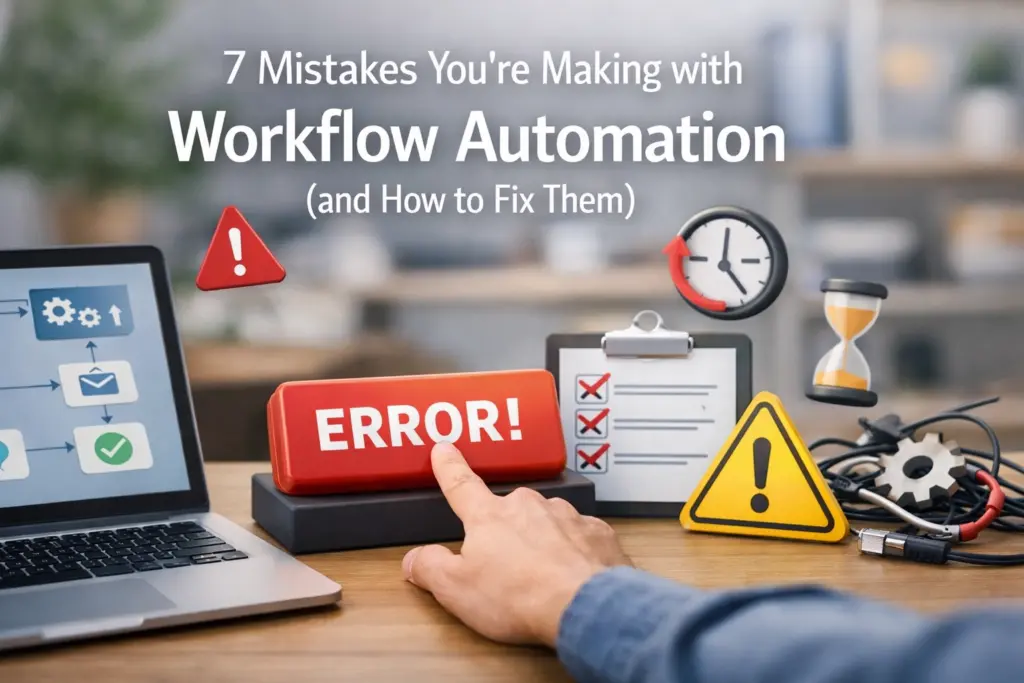
Here are the 7 biggest mistakes I see founders making right now and exactly how to fix them.
1. You Have No Clear North Star
Most people start automating because they heard it’s "the thing to do."
They don't have a goal. They just want to "be automated." This is a recipe for wasted time. Without a measurable objective, you’re just moving data around for no reason.
The Fix:
Before you touch a single tool, ask: What is the win here?
- Are we trying to save 10 hours a week on client onboarding automation?
- Are we trying to increase the conversion rate of our sales funnel?
- Are we trying to eliminate human error in our crm setup?
Write it down. If you can’t measure the impact, don't build the automation.
2. You’re Automating "Easy" Instead of "Impactful"
I see founders spend three days automating a task they only do once a month.
Why? Because it was easy to set up. Meanwhile, their lead generation funnel is leaking money because they’re manually following up with 50 leads a day.
The Fix:
Map your daily workflow. Look for the bottlenecks.
Find the tasks that are:
- High volume.
- Repetitive.
- Prone to human error.
- Boring as hell.
That’s where the ROI is. Focus on marketing automation that actually moves the needle on your revenue, not just your ego.

3. Paving the Cow Path (Automating a Broken Process)
This is the most dangerous mistake on this list.
If your manual process is messy, your automated process will be a disaster: just faster. Automation doesn't fix a bad strategy. It scales it.
If your sales funnel strategy is confusing for a human, a robot isn't going to make it clearer. It’s just going to confuse your customers at lightning speed.
The Fix:
Standardize before you automate.
Walk through the process manually five times. Strip away the fluff. Delete the unnecessary approval steps. Once the manual flow is lean and mean, then: and only then: bring in the software.
A clean manual process is the foundation of a world-class crm automation system.
4. Building a Digital Rube Goldberg Machine
I’ve seen Zaps with 45 steps.
It looks impressive. It feels like you’re building a rocket ship. But you know what happens when step 22 fails? The whole thing dies. And you spend your entire Saturday trying to figure out why a lead didn't get their PDF.
The Fix:
Keep it simple.
Not everything needs to be automated. Some things still require a human touch. Use the "80/20 rule" for your workflows.
Evaluate which parts of the process are strictly logic-based and which ones need a brain. Start with a high-impact, single-step automation. Gather data. Refine. Only then should you add complexity.
If you want to see how I structure these simple, high-converting flows, check out my Marketing Foundations Course.
5. The "Lone Wolf" Implementation
You’re the CEO. You’re the visionary.
You spend a weekend building a brand new automated follow up system. On Monday, you hand it to your team. They hate it. Why? Because it doesn't actually fit how they work.
A top-down approach to automation almost always fails.
The Fix:
Talk to the people in the trenches.
The person answering the support tickets knows the pain points better than you do. The salesperson knows why the crm setup is annoying.
Involve your team in the planning phase. Ask them: "What is the one task you wish you never had to do again?" Use their answers to guide your build. They’ll be much more likely to use a tool they helped design.

6. Zero Training for the Humans Involved
Automation is supposed to replace work, not people.
But people still need to know how to interact with the system. If your team doesn't understand the new workflow automation, they’ll find workarounds. They’ll start using private spreadsheets again.
Suddenly, your "automated" business is more fragmented than ever.
The Fix:
Training isn't an afterthought. It's the job.
When you roll out a new system, create a short Loom video. Document the "why" and the "how." Ensure everyone knows what to do when (not if) the automation hits a snag.
Successful business automation requires a culture shift, not just a software login. You can read more about this in my previous post on the automation mindset.
7. The "Big Bang" Approach
You decide to automate your entire business in a week.
You change the CRM, the email provider, the onboarding flow, and the billing system all at once. Your team is overwhelmed. Your data is a mess. Your customers are getting three different welcome emails.
The Fix:
Incremental gains over total overhauls.
Pick one workflow. Fix it. Optimize it. Let it run for a week.
Once it's stable, move to the next. This phased approach allows you to catch errors before they become catastrophes. It also keeps your team’s stress levels down.
Slow is smooth, and smooth is fast.
My Take on Automation
I’ve spent years building systems for myself and for clients at Patric B.
Here is what I’ve learned: Automation is about leverage.
It’s about making sure that your time: the only non-renewable resource you have: is spent on things that actually matter. Whether that’s closing a high-ticket deal or spending the afternoon with your family, the goal is the same.
But remember, you can't automate your way out of a bad business model.
Start with the strategy. If you need help figuring out what to automate first, have a look at our business automation guide for 2026.

Frequently Asked Questions
Which tool should I start with?
It depends on your stack, but for most small businesses, a solid CRM is the heart of everything. Once your crm setup is clean, you can use tools like Zapier or Make to connect the rest of your world.
Is automation expensive?
Not compared to the cost of a human doing manual data entry. You can start with free tiers for most tools. The real "cost" is the time spent building it wrong.
How do I know if a process is ready for automation?
If you can write down the "If This, Then That" logic on a napkin, it’s ready. If it requires "judgment" or "intuition" at every step, it’s not.
Can I automate my lead generation?
Absolutely. A lead generation funnel combined with automated follow up is the fastest way to scale your revenue without scaling your workload.
Ready to Scale?
Building a business that runs without you isn't a pipe dream. It’s a series of deliberate choices.
Stop making these 7 mistakes and start building for real growth.
If you want to skip the trial and error and get a system that works from day one, let’s talk. I help founders bridge the gap between "working in the business" and "owning the business."
Ready to get started?
Stop being the bottleneck in your own company. The robots are waiting.
Stay direct,
Patric