You’re busy. I get it.
You started your business to build something great, not to spend four hours a day copy-pasting data between spreadsheets. Yet, here you are. You’re the CEO, the marketing department, and the person manually sending "Welcome" emails at 11:00 PM.
You are the bottleneck.
If you stop moving, the business stops growing. That’s a job, not a company.
I’ve seen it a thousand times. Founders think they need more "hustle." In reality, they just need a better engine. I'm talking about workflow automation for small business.
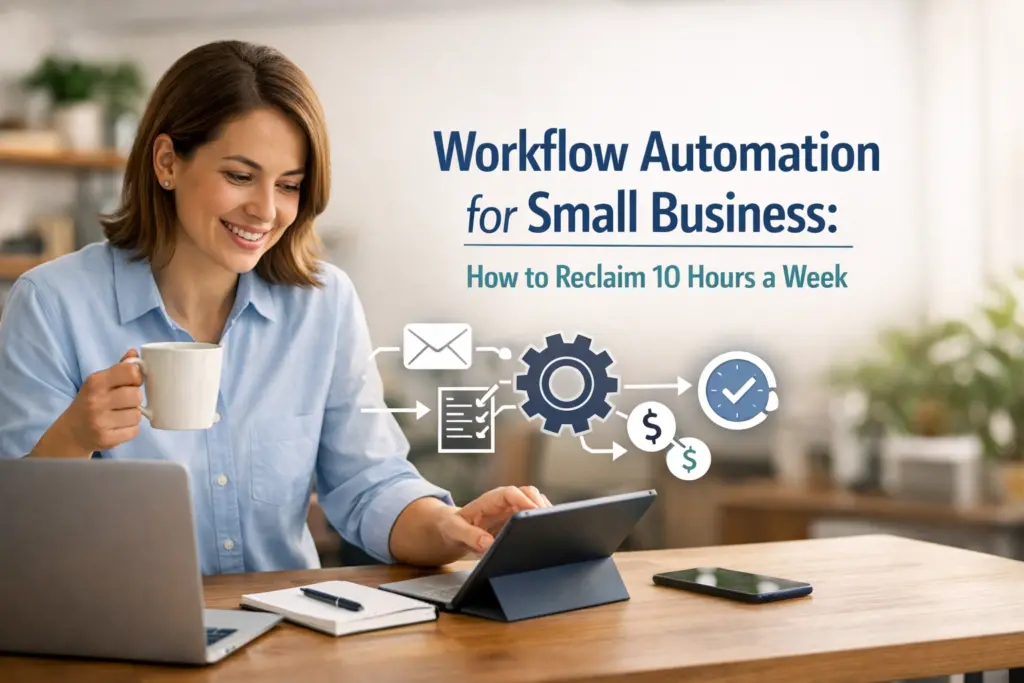
Today, we’re going to find your missing 10 hours. We aren't just talking about abstract concepts. We’re going to build a system that works while you sleep.
The "Admin Tax" is Killing Your Growth
Every time you manually move a lead from a contact form to your CRM, you pay the "Admin Tax."
Every time you send a follow-up email because you remembered it three days late, you pay the tax.
Research shows that manual data entry and repetitive admin tasks consume hours of daily work. For most small business owners, this adds up to over 10 hours every single week.
Think about that. Ten hours.
That’s a full working day plus a long lunch. Reclaimed. Every week.
What would you do with that time?
- Close three more deals?
- Finally launch that new product?
- Actually see your family for dinner?
The choice is yours. But first, we have to kill the manual labor.

1. Automated Client Onboarding: From "Paid" to "Done"
This is the biggest time-sink I see.
A client pays an invoice. Great! Now the work starts. You have to:
- Send a thank-you email.
- Send a contract or NDA.
- Create a folder in Google Drive.
- Invite them to your project management tool.
- Schedule a kickoff call.
If you do this manually, it takes 45 minutes of clicking around. If you do it with client onboarding automation, it takes zero seconds.
How it looks in Orbit CRM:
The moment a payment is confirmed, Orbit triggers a sequence.
- Step 1: The contract is automatically sent via email.
- Step 2: Once signed, a "Welcome Kit" PDF is delivered.
- Step 3: A Slack notification alerts your team.
- Step 4: The client is tagged as "Active" in your database.
You didn't lift a finger. The client feels like they’re working with a Fortune 500 company. You look like a pro.
2. The Fortune is in the (Automated) Follow-Up
Most small businesses lose money because they "ghost" their own leads.
Someone fills out your contact form. You’re in a meeting. You forget to reply. Two days later, they’ve already hired your competitor.
Business automation solves this instantly.
A lead tracking system ensures no one falls through the cracks. You need a sequence that triggers the second a lead enters your world.
The "Speed to Lead" Sequence:
- 0 Minutes: Automated SMS: "Hey [Name], got your request! I'm tied up for 20 mins, but check out this case study while you wait."
- 5 Minutes: Automated Email with your booking link.
- 24 Hours: Follow-up email if they haven't booked a call yet.
This isn't "impersonal." It’s professional. It shows you value their time. If you want to dive deeper into this mindset, check out why founders who automate sleep better.

3. Lead Tracking and CRM Setup
If you’re still tracking leads in your head or a "Notes" app, stop. Just stop.
A proper CRM setup is the spine of your business. It tells you exactly where your money is.
I’ve built Orbit CRM to handle this specifically for small businesses. You shouldn't need a PhD to manage your pipeline. You just need to see who needs a call and who is ready to buy.
Stop the Data Entry Nightmare
Research shows that automating data processing can reduce setup times from 5 days down to under 24 hours.
By connecting your lead sources (Facebook Ads, Website, LinkedIn) directly to your CRM, you eliminate the "copy-paste" cycle.
When the data flows automatically:
- Invoices are more accurate.
- Customer records are always up to date.
- You stop making "I forgot" excuses to your clients.
4. Internal Task Routing
Workflow automation isn't just for clients. It’s for your team.
When a project hits a certain stage, who knows about it?
Do you have to send a manual message saying "Hey, the design is done, you can start the coding"?
That’s a waste of energy.
Set up triggers. When a task status changes to "Review," the manager gets an alert. When the manager approves, the client gets a notification.
This reduces "task switching." Task switching is the silent killer of productivity. Every time you stop to send a "status update" email, it takes your brain 20 minutes to get back into deep work.
Automate the updates. Keep the focus.

Common Objections (The "Yeah, But…" Section)
"Is it expensive?"
Not at all. Most automation tools cost between $10 and $50 a month. Compare that to the cost of your time. If you value your time at $100/hour, you’re losing $1,000 a week by being manual. The ROI is immediate.
"Will it feel robotic?"
Only if you write like a robot. Use your voice. Use your "Patric B." style. Automation is just the delivery vehicle. The message is still you.
"It's too complicated to set up."
It can be. That’s why you don’t do it all at once. Start with one thing. One high-impact, repetitive task. Usually, that’s lead capture or onboarding. Once that works, move to the next.
My Take: The Scale or Fail Reality
Here is the cold, hard truth.
In 2026, you cannot compete if you are manual. Your competitors in Dubai and across the globe are using AI and systems to move 10x faster than you.
If it takes you three days to onboard a client and it takes your competitor three minutes, you lose. Every time.
Automation isn't a "luxury" for when you get big. Automation is how you get big.
You need to shift from a "doer" mindset to an "architect" mindset. Stop building the product every day and start building the machine that builds the product.
I’ve talked about this before in my post on the automation mindset. If you haven't read it, you should. It’s the foundation for everything we do at Orbit.
Your First 10 Hours are Waiting
You don’t need to work harder. You need to work smarter.
Workflow automation for small business isn't about replacing people. It’s about freeing people to do the work that actually matters.
Let the software handle the boring stuff. You handle the strategy, the relationships, and the growth.
Are you ready to stop being the bottleneck?
I want to help you find those 10 hours. I don't care if you're just starting out or if you're already doing six figures and drowning in admin. There is always a better way to build.
Here’s the move:
Book an automation audit.
We’ll sit down, look at your current "mess," and find exactly where we can plug in systems to reclaim your time.
No fluff. No jargon. Just a direct plan to get your life back.
Let's build your engine.
Looking for more tips on scaling? Check out the Marketing Foundations Course or see what else is happening in Business Automation in 2026.