
You’re tired. I know it.
You started this business for freedom, but lately, it feels like the business owns you. You’re answering the same emails. You’re manually moving data from a lead form to a spreadsheet. You’re chasing invoices.
It’s Monday, March 30, 2026. The world is moving faster than ever. If you’re still doing things "by hand," you aren’t just behind: you’re actively killing your growth.
I’ve seen this a thousand times. Founders think they can "brute force" their way to the next revenue milestone. They think hiring one more assistant will fix the bottleneck.
It won’t.
To scale in 2026, you need to stop being the engine and start being the architect. You need to make the Orbit Business shift.
The Trap of Linear Scaling
Most small businesses scale linearly.
To double your output, you think you need to double your workforce. Or double your hours. That’s a trap.
Research shows that knowledge workers spend roughly 40% of their time on manual administrative tasks. Think about that. Nearly half your day is wasted on work that doesn't actually grow the business.
Even worse? 62% of the average workday is lost to repetitive tasks.
When you scale manually, your costs rise exactly as fast as your revenue. Your margins stay thin. Your stress stays high. And eventually, you hit a ceiling. You can't work 25 hours a day.
This is where business automation changes the game.

What is an Orbit Business?
I call it the Orbit Business model.
In a traditional setup, the founder is the sun, and they have to manually pull every planet (task) into place. If the founder stops pulling, the system collapses.
In an Orbit Business, you build a "gravitational" system of workflow automation for small business.
You are still the center. But the planets: your lead generation funnel, your client onboarding automation, and your automated follow up: spin on their own. They don't need you to push them.
They orbit you. You just watch the data and adjust the trajectory.
Pillar 1: The CRM Automation Power-Up
If your CRM is just a digital Rolodex, you’re doing it wrong.
A proper CRM setup should be the heartbeat of your company. It shouldn’t just store names; it should trigger actions.
When a lead enters your world, what happens?
- Do they wait 24 hours for you to see the email?
- Do you have to manually type a "Thanks for reaching out" message?
That’s a growth killer. CRM automation ensures that the second a lead hits your site, they are tagged, segmented, and put into a sequence.
Why CRM Setup Matters
Most founders mess up the initial setup. They skip the custom fields. They ignore the pipeline stages.
But a solid CRM setup allows you to see exactly where money is leaking. It lets you automate the "boring" stuff so you can focus on the "selling" stuff.
If you haven't optimized your stack yet, check out my Business Automation in 2026 guide to see what's currently working.
Pillar 2: The Sales Funnel Strategy
You need a sales funnel strategy that filters out the noise.
Stop hopscotching between "marketing ideas." You need a predictable lead generation funnel.
- The Hook: High-value content or an offer.
- The Filter: A way to qualify leads automatically.
- The Close: An automated path to booking a call or buying.
If you are still manually qualifying leads, you are losing money. A high-converting sales funnel does the heavy lifting for you. It educates the prospect. It handles objections. By the time they get on a call with you, they’re already sold.
Want to build this properly? My Marketing Foundations Course walks you through the exact architecture I use.
Pillar 3: Client Onboarding Automation
Nothing kills a new client’s excitement faster than a messy onboarding process.
You've just closed the deal. Now you need the contract signed. You need the first invoice paid. You need their brand assets.
If this involves four different emails and three days of waiting, you’ve already lost momentum.
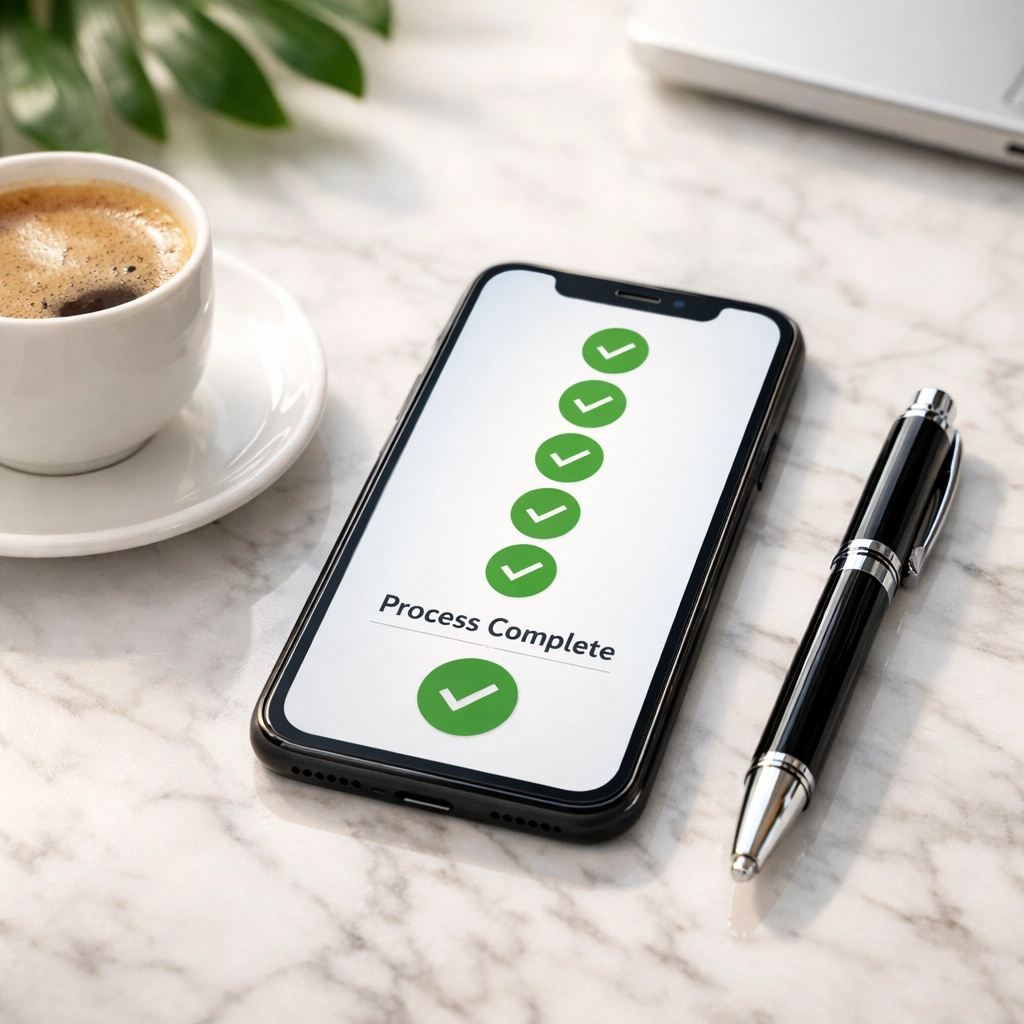
Client onboarding automation should happen in minutes, not days.
- Contract sent automatically upon "Closed Won" status.
- Invoice triggered immediately.
- Welcome portal access granted once the payment clears.
This isn't just "nice to have." It’s professional. It sets the tone. And most importantly, it frees up your team to actually deliver the service instead of chasing PDFs.
Pillar 4: The Fortune is in the Automated Follow Up
We’ve all heard it: The fortune is in the follow-up.
But let’s be real. You’re busy. You forget to follow up with that lead from three weeks ago. We all do.
This is where marketing automation saves your bottom line. An automated follow up sequence ensures that no lead is ever truly "cold" until they tell you to go away.
- Day 1: Value-add email.
- Day 3: Case study.
- Day 7: Direct offer.
- Day 14: "Still interested?" nudge.
You write it once. It works forever. That is how you break the linear scaling limit.
The Efficiency Gap: 2026 Edition
In 2026, the gap between "automated" businesses and "manual" businesses is a canyon.
If your competitor is using workflow automation for small business to handle 80% of their admin, they have 80% more time to innovate. They have 80% more time to talk to customers. They have 80% more time to steal your market share.
Manual work isn't just slow. It’s expensive.
- Manual data entry leads to errors.
- Errors lead to unhappy clients.
- Unhappy clients lead to churn.
You can't afford to be the bottleneck anymore. As I mentioned in my recent post on The Automation Mindset, scaling is about letting go.
How to Start Your Orbit Shift
You don’t have to automate everything overnight. Start where the friction is highest.
1. Audit Your Week
Track your time for three days. Every time you do a task that feels like "copy-paste," write it down. Those are your first candidates for automation.
2. Fix Your Lead Gen
Build a lead generation funnel that works without you. Use a tool that integrates with your CRM. Don't let leads sit in your inbox.
3. Standardize the Sales Process
Map out your sales funnel strategy. What are the stages? What information do you need at each step? Automate the transition between those stages.
4. Book a Strategy Session
Sometimes you’re too close to the problem to see the solution. If you're ready to stop the manual grind, let’s talk. We can map out your Orbit Business shift together.

My Take
I’ve been where you are. I remember the feeling of "if I don't do it, it won't get done."
It’s a lie we tell ourselves to feel important.
The truth? Your business will never be bigger than your own personal bandwidth until you automate. The "Orbit Business" shift isn't about being lazy. It’s about being effective.
It’s about building a machine that makes money while you sleep, while you travel, or while you're focused on the next big thing.
Stop doing $20/hour work when you should be making $2,000/hour decisions.
Manual work is a choice. In 2026, it's a choice to stay small. Choose growth instead.
FAQ: Common Automation Doubts
"Will automation make my business feel cold or robotic?"
Not at all. When you automate the boring stuff, you have more time for high-quality, personal human interactions. You’re not a robot; your systems are.
"Isn't automation expensive?"
It’s cheaper than a full-time employee. Most CRM automation and workflow automation tools pay for themselves within the first month by reclaiming lost hours.
"What if the technology breaks?"
That’s why you need a proper CRM setup and a solid foundation. Systems need maintenance, but a broken automation is easier to fix than a burnt-out founder.
Ready to stop the manual madness?
Check out my Marketing Foundations Course to get your systems right the first time. Or, if you want a custom roadmap, contact me here.
Stay sharp. Stay automated.
( Patric)
We help service-based businesses grow with proven strategies:
- Learn Marketing & SEO Strategies → itspatricb.com
- Work With a Marketing Agency in Dubai → camouflage-media.com
- Use an All-in-One CRM for Service Businesses → orbit-business.com