It’s Automation Monday.
Most people are still stuck in 2023. They think automation is just connecting App A to App B. They think a "Zap" is the peak of efficiency.
They’re wrong.
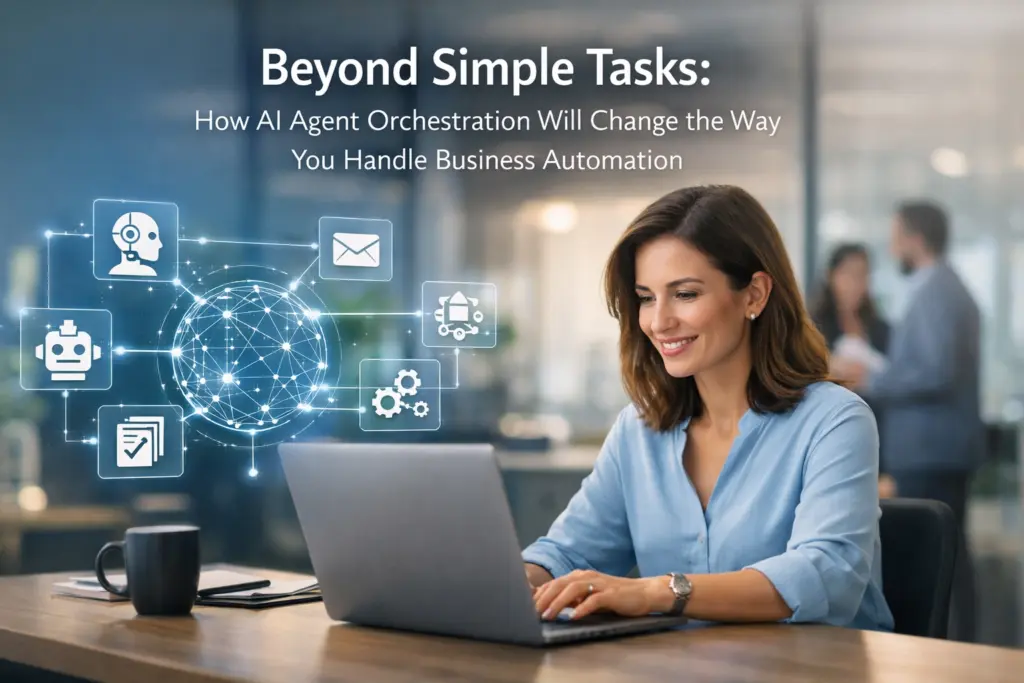
By now, in March 2026, the game has shifted. We’ve moved past simple triggers. We are now in the era of AI Agent Orchestration.
If you aren’t using this yet, you’re working too hard. You’re leaving money on the table. And honestly? You’re probably exhausted.
I’ve spent the last few years obsessed with one thing: Efficiency. I want to show you how to stop managing tasks and start leading a digital workforce.
What is AI Agent Orchestration?
Let’s keep it simple.
Standard business automation is a linear line. If This happens, do That. It’s rigid. It breaks easily.
AI Agent Orchestration is a spiderweb. It’s a group of specialized AI agents talking to each other. They share context. They make decisions. They solve problems without you.
Think of it like a professional kitchen.
- You have a chef (The Orchestrator).
- You have a prep cook (Data Agent).
- You have a saucier (Content Agent).
- You have a server (Communication Agent).
In the old days, you had to be the chef. You had to tell everyone exactly what to do every second.
With orchestration, you just tell the Orchestrator: "We need 50 steaks served by 8 PM." Then you walk away. The agents handle the rest.
Why 2026 is the Year of the Agent
I’ve seen the shift firsthand.
In early 2024, AI agents were "cool" but buggy. They hallucinated. They got stuck in loops.
Today, things are different. The models are faster. The logic is tighter. We’ve figured out how to build "guardrails" that keep them on track.
Small businesses are finally getting enterprise-level power. You don’t need a $200k/year developer anymore. You need a solid strategy and the right ecosystem.

The "Dream Team" Workflow
Let’s look at a real-world example. Imagine you want to grow your outbound sales.
In the old world, you’d hire a Virtual Assistant. They’d spend hours on LinkedIn. They’d copy-paste data into a spreadsheet. You’d then manually upload that to a CRM.
Here is how we do it now with orchestration:
1. The Research Agent
This agent lives on the web. It monitors your target industry. When a company hits a specific milestone, maybe they just raised a seed round, it triggers.
It doesn't just grab the name. It reads their latest blog post. It looks at the CEO’s recent tweets. It gathers real context.
2. The Analyst Agent
The Research Agent passes that data to the Analyst. This agent determines if they are a "Good Fit."
If the company is too small? It drops them. If they’re perfect? It moves them to the next stage. It’s making a judgment call based on your criteria.
3. The Content Agent
This is where the magic happens. The Content Agent takes the research and the analysis. It writes a personalized outreach email.
It doesn't use a template. It references the specific blog post the CEO wrote. It connects their pain points to your solution.
4. The CRM Agent (Orbit CRM)
Finally, everything is pushed into Orbit CRM.
The contact is created. The research notes are attached. The email is scheduled. All of this happens while you’re having your morning coffee. This is CRM automation at its finest.
How We Use Orbit CRM and Camouflage Media
I don't just talk about this. I live it.
Inside my ecosystem, Orbit CRM is the "Brain." It’s where all the data lives. It’s the single source of truth. If it isn't in the CRM, it didn't happen.
But data without creative is boring. That’s where Camouflage Media comes in.
We use orchestrated agents to fuel our creative processes. An agent might analyze high-performing ad trends. It then briefs our human creative team at Camouflage Media.
The AI handles the heavy lifting of research and data. The humans handle the high-level strategy and "soul" of the brand.
This combination is why our clients are winning. We are faster. We are more accurate. We are more efficient.
Workflow Automation for Small Business: Is it too complex?
I hear this a lot. "Patric, this sounds like sci-fi. I just sell plumbing supplies."
Not at all.
Orchestration is actually simpler for you in the long run.
Why? Because you don't have to manage the "glue" between apps anymore. You just define the outcome.
If you're a small business owner, you're likely wearing ten hats. You're the CEO, the janitor, and the marketing lead.
Workflow automation for small business isn't about replacing people. It’s about giving those people (including you) their time back.
Imagine your inbox sorting itself. Imagine your lead follow-ups happening automatically for months. Imagine your social media content being drafted based on your actual work calls.
That’s not the future. That’s today.

The Strategic Advantages
Why should you care? Here are three reasons:
- Scalability: Agents don't get tired. They don't ask for raises. They work 24/7. You can double your output without doubling your headcount.
- Reliability: Humans make mistakes. We forget to follow up. We mistype names. Orchestrated agents follow the protocol every single time.
- Speed: An agent can research 100 leads in the time it takes you to open a browser tab. In 2026, speed is the only real competitive advantage left.
Stop Micromanaging, Start Scaling
I wrote about this recently in my post on The Automation Mindset.
The biggest hurdle isn't the technology. It’s your brain.
You have to trust the system. You have to move from "doing" to "approving."
In an orchestrated world, your job changes. You become an Editor-in-Chief. You review what the agents produce. You tweak the strategy. You give the final "Green Light."
This is how founders who automate sleep better and make more money.
FAQ: Your Doubts Answered
"Won't this make my business feel robotic?"
Actually, it’s the opposite. Because agents gather more data, your outreach becomes more personal. No more "Hey [First_Name], hope you are well." Now it's "Hey [First_Name], I loved your point about [Specific Topic] in your podcast yesterday."
"Is it expensive?"
It’s cheaper than a bad hire. Think about the cost of a missed lead. Think about the cost of your own time. Orchestration is an investment that pays for itself in weeks.
"Do I need to be a coder?"
No. Tools like Orbit CRM are designed to be user-friendly. Most orchestration happens via visual builders or plain-English prompts.
My Take
I’ve been building systems for years. I’ve seen every "next big thing" come and go.
AI Agent Orchestration is different.
It is a fundamental shift in how we interact with computers. We are moving from "Software as a Tool" to "Software as a Teammate."
If you are still doing manual data entry, you are a dinosaur. And we all know what happened to them.
My advice? Start small.
Pick one workflow. Maybe it’s your lead intake. Maybe it’s your customer onboarding. Automate it. Then, add a second agent to assist that automation.
Before you know it, you’ll have a symphony of efficiency running in the background.
Ready to Level Up?
If you want to see how we can build these systems for you, let's talk.
We specialize in taking the mess of your daily operations and turning it into a streamlined machine.
- Check out our multi-purpose solutions.
- Or, if you’re ready to dive in, book a call on my calendar.
Stop working for your business. Let your business work for you.
Stay efficient.
– Patric
Related Reading:
- Business Automation in 2026: What to Automate and What to Avoid
- New in the UAE: The Mulin Content Creator Permit Explained
- Marketing Automation Trends
We help service-based businesses grow with proven strategies:
- Learn Marketing & SEO Strategies → itspatricb.com
- Work With a Marketing Agency in Dubai → camouflage-media.com
- Use an All-in-One CRM for Service Businesses → orbit-business.com