You're stuck in your inbox at 11 PM. Again.
A client needs an invoice. Another one hasn't received their onboarding email. Someone's asking about next steps after a discovery call. And you're manually handling every single piece of it, copying, pasting, clicking, sending.
This isn't scaling. This is survival mode.
And here's the thing: you already know you need to automate. You've read the articles. You've seen the tools. But something keeps pulling you back into the weeds, double-checking everything, doing it "just this once" because it's faster than setting up a system.
I've been there. I get it.
But let me tell you what changed everything for me, and what I see transform businesses every single week.
The Real Problem Isn't Time. It's Mindset.
Most founders don't have an automation problem. They have a control problem.
You think:
- "It's faster if I just do it myself."
- "No one else will do it right."
- "I need to be involved in every client interaction."
Sound familiar?
Here's what actually happens when you operate like this:

You become the bottleneck. Every decision flows through you. Every task waits for you. And when you finally take a day off? Everything stops.
That's not a business. That's a really expensive job.
The automation mindset flips this entirely. Instead of asking "who's going to handle this?" you start asking "how can this run without me?"
It's not about being lazy. It's about being strategic.
What the Automation Mindset Actually Looks Like
The shift is simple but powerful:
Old thinking: "I need to send this proposal to the client."
Automation thinking: "How can proposals go out automatically after discovery calls?"
Old thinking: "I should follow up with that lead."
Automation thinking: "What triggers a follow-up sequence when someone downloads my guide?"
Old thinking: "Let me manually onboard this client."
Automation thinking: "What does a perfect client onboarding automation look like?"
See the difference?
You're not removing yourself from the business. You're removing yourself from repetitive execution so you can focus on the stuff that actually moves the needle, strategy, relationships, creative problem-solving.

Why You're Still Stuck Doing Everything Manually
Let me guess what's holding you back:
"Setting up automation takes too much time."
Sure, it takes 2 hours upfront. But then it saves you 2 hours every single week. That's 104 hours a year. You do the math.
"I don't know where to start."
Start with what pisses you off the most. What task makes you think "I can't believe I'm doing this again"? That's your first automation target.
"What if something breaks?"
It might. Once. Then you fix it. And it runs flawlessly for months. Compare that to manually doing it wrong because you're exhausted at 10 PM.
"My business is too unique for automation."
No, it's not. I've automated everything from client onboarding to proposal delivery to payment reminders. If it's repetitive, it's automatable.
The Three Types of Tasks You Should Automate First
Not everything needs automation. But these three categories? Automate them immediately.
1. Repetitive Tasks
Anything you copy-paste more than twice a week needs a workflow.
Examples:
- Sending the same email sequences
- Creating invoices for standard services
- Updating CRM records after calls
- Posting content across platforms
2. Fragile Tasks
Things that break when you're tired, distracted, or juggling too much.
Examples:
- Data entry between systems
- Client onboarding steps that can't be skipped
- Payment collection and follow-ups
- Lead qualification and routing
3. Timely Tasks
Anything that needs to happen at a specific moment: and you keep forgetting.
Examples:
- Follow-up emails after discovery calls
- Meeting reminders and confirmations
- Renewal notifications
- Client check-ins at 30/60/90 days
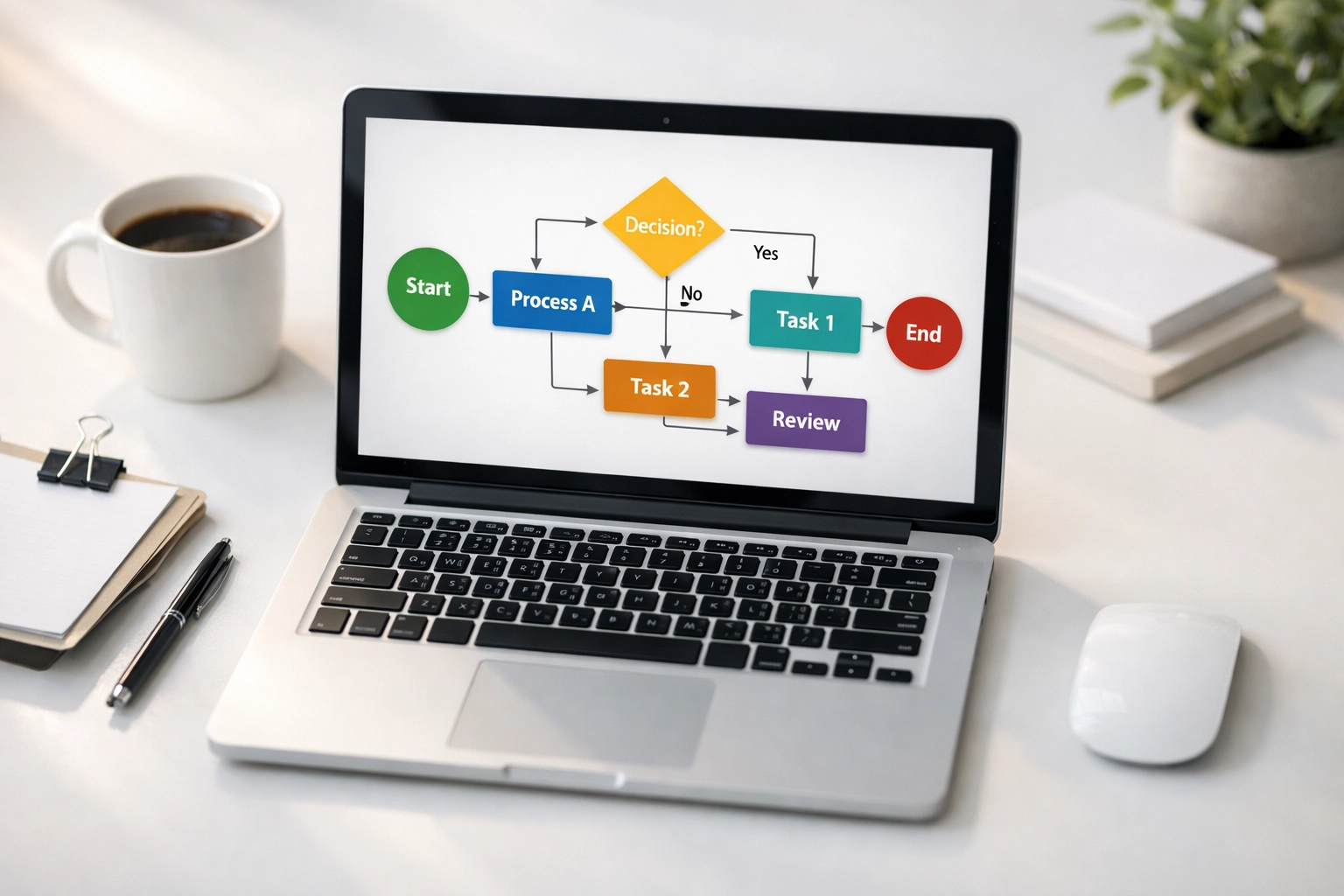
When you automate these three types of work, something magical happens: you stop micromanaging and start scaling.
How to Actually Make the Shift
Here's the process I use: and what I teach inside Orbit Business:
Step 1: Document what you're currently doing manually.
Spend one week tracking every repetitive task. Write it down. Every. Single. One.
Step 2: Pick the biggest time-suck.
What task shows up most often? What's eating hours every week? That's your starting point.
Step 3: Map the ideal workflow.
Write out exactly how this should work: from trigger to completion: if you weren't touching it.
Step 4: Build it in your automation tool.
This is where workflow automation for small business becomes your superpower. Tools like Orbit Business let you connect your CRM, email, calendar, and payments into one seamless system.
Step 5: Test, tweak, and let it run.
Don't aim for perfection. Aim for "works." Then improve it as you go.
Step 6: Repeat.
Once you've automated one thing, the next one gets easier. And faster. And more obvious.
What This Actually Looks Like in Practice
Let's say you're tired of manually onboarding every new client. Here's what client onboarding automation looks like when you think systems-first:
Trigger: Client signs contract and pays invoice.
What happens automatically:
- Welcome email sends with next steps
- Client gets added to your CRM with tags
- Onboarding questionnaire goes out
- Calendar link for kickoff call is sent
- Slack/email notification goes to your team
- Project board is created with their info pre-filled
You? You don't touch any of it.
You just show up to the kickoff call, fully prepped, while your client thinks you've got the most dialed-in operation they've ever seen.
That's the automation mindset in action.

The Real Result: Time Freedom
Here's what happens when you stop micromanaging and start automating:
- You reclaim 10-20 hours a week
- Clients get faster, more consistent experiences
- Your team (or future team) knows exactly what to do
- You can actually take a weekend off without everything falling apart
- Scaling stops feeling impossible
And the best part?
You stop being the bottleneck.
Your business doesn't wait for you anymore. It runs. It grows. It scales: because the systems do the heavy lifting.
My Take
I spent years thinking I needed to be involved in everything. That's what "good business owners" did, right?
Wrong.
The best business owners build systems that work without them. They focus on high-level strategy while automation handles the repetitive grind.
When I finally made the shift: when I stopped asking "who will do this?" and started asking "how can I automate this?": everything changed.
I wasn't working harder. I was working smarter.
And that's exactly what business automation is designed to do.
If you're ready to stop micromanaging every task and start building systems that scale, Orbit Business is built for exactly this. We help you map your workflows, automate your client journey, and free up your time so you can focus on what actually matters.
Let's build your automation stack: one workflow at a time.